

Chest discomfort, palpitations, breathlessness, or fainting can make you search for a nearby ECG or TMT, but the right test depends on the symptom, timing, and your ability to exercise safely. By the end, you will know when an ECG is appropriate, when a TMT adds useful information, when emergency care comes first, and what to confirm before booking.
Key takeaways
- Ask for an ECG when symptoms suggest an abnormal rhythm or heart problem.
- A TMT assesses the heart during exercise when a clinician needs additional evidence.
- Seek emergency care for severe or persistent chest pain, breathlessness, or fainting.
- A normal result lowers concern but does not rule out every heart condition.
When is an ECG recommended for heart symptoms?
Ask a clinician for a resting 12-lead ECG when symptoms could reflect an abnormal heart rhythm, reduced blood flow, or another electrical problem. When is an ECG recommended? The answer depends on your symptoms, medical history, examination, and risk factors—not on age alone.
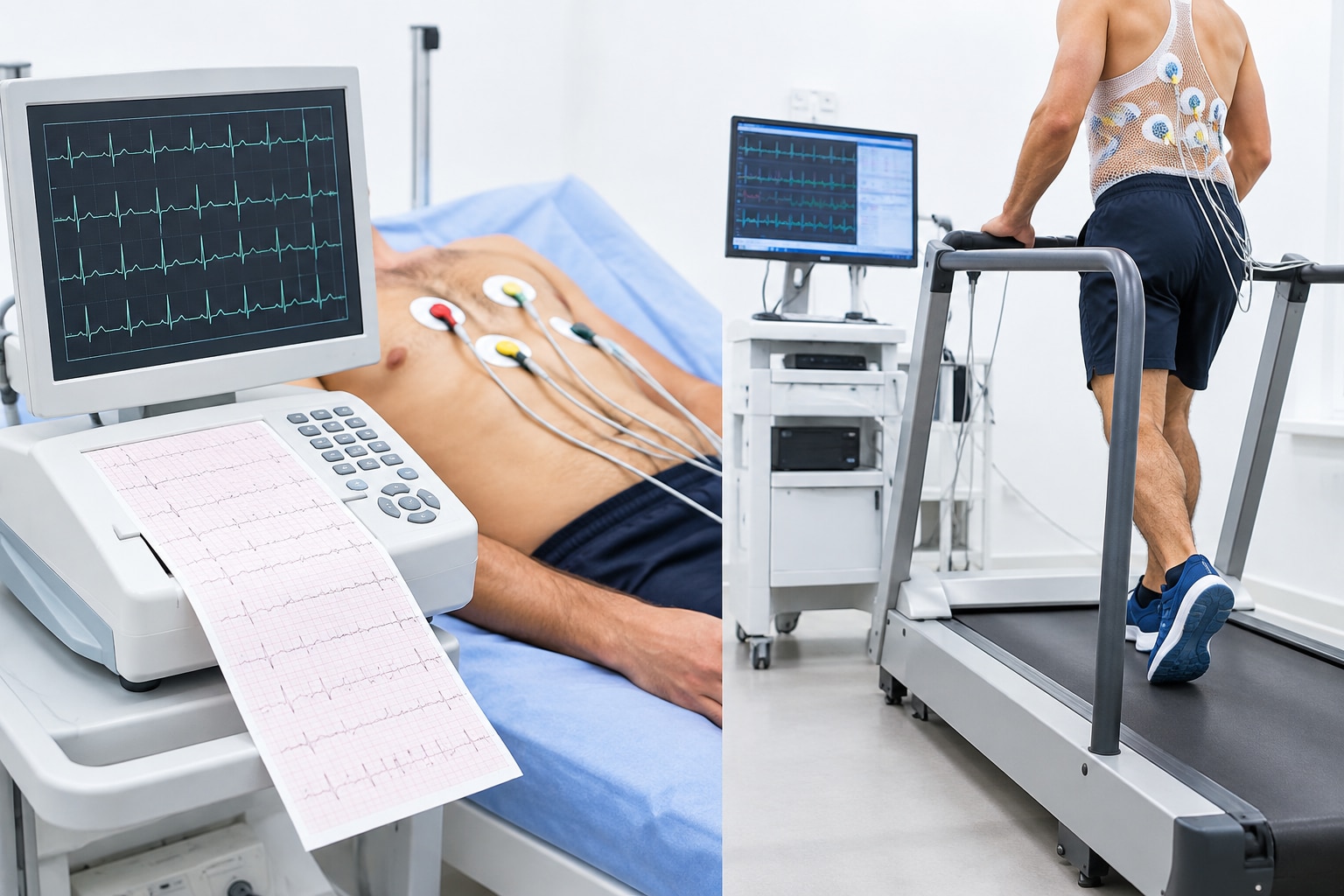
A resting ECG records the heart’s electrical activity at one moment. Twelve leads show the heart rate, rhythm, conduction intervals, and electrical patterns that can suggest a current or previous heart injury. It does not show a narrowed coronary artery directly, so a normal tracing cannot exclude every heart problem.
| Situation | Why an ECG may be ordered | Appropriate next step |
|---|---|---|
| Chest pain or pressure | Looks for rhythm changes or patterns suggesting heart muscle injury | Seek urgent assessment for severe, persistent, or spreading pain |
| Palpitations or an irregular pulse | Helps identify an arrhythmia or conduction problem | Arrange prompt clinical review |
| Fainting, near-fainting, or unexplained dizziness | Checks for rhythm or conduction abnormalities | Do not drive if episodes recur |
| Breathlessness without a clear cause | Adds cardiac information to the examination | Follow the clinician’s testing plan |
| Known heart disease or suspected arrhythmia | Establishes or monitors cardiac electrical status | Ask whether repeat ECG or longer monitoring is needed |
| Medication review or preoperative assessment | Detects changes that affect treatment or surgical planning | Have your medicine list and prior reports available |
An ECG for chest pain and palpitations is not a reason to self-diagnose. Search for an “ECG test near me” only after confirming whether outpatient testing is suitable; sudden severe symptoms require immediate medical care.
When does a clinician recommend a TMT?
A treadmill test (TMT), also called an exercise ECG or exercise stress test, records your heart’s electrical activity, heart rate, blood pressure, symptoms, and exercise tolerance as the workload increases. It can show exertion-related ECG changes or abnormal rhythm, but it does not directly show blocked coronary arteries.
A clinician may recommend TMT for:
- Exertional chest discomfort or breathlessness, including a TMT for chest pain and breathlessness when symptoms suggest reduced blood flow during activity.
- Suspected stable coronary artery disease, if you can exercise adequately and your resting ECG allows reliable ST-segment interpretation.
- Treatment follow-up, to compare symptoms, exercise response, blood pressure, or rhythm after treatment for suspected or known heart disease.
- Exercise-capacity assessment, such as measuring how far and how hard you can exercise safely in a controlled setting.
Exercise testing is not a test for an active heart attack, ongoing chest pain at rest, or suspected acute coronary syndrome. Defer it until a clinician assesses you if you have uncontrolled arrhythmia, worsening heart failure, severe symptomatic aortic stenosis, or another condition that makes exertion unsafe.
If you search for a TMT test near me, ask whether a clinician has confirmed that exercise ECG is the right test. People unable to exercise adequately, or whose resting ECG obscures interpretation, may need stress imaging or coronary CT angiography instead.
A TMT result must be read alongside your symptoms, risk factors, examination, and other test results.
Should you book a routine test or seek emergency care?
Call emergency services rather than booking a routine appointment for chest pressure or pain that lasts more than a few minutes, occurs at rest, returns repeatedly, or spreads to the arm, back, jaw, or neck. Treat breathlessness, cold sweating, nausea, fainting, or sudden severe weakness with chest symptoms as ECG emergency symptoms.
Do not drive yourself.
New, worsening, or unpredictable chest discomfort can indicate acute coronary syndrome or unstable angina, even if the pain settles. Seek urgent assessment; an outpatient TMT is not a safe first step. Emergency clinicians may need serial ECGs and troponin blood tests.
You can discuss outpatient testing when symptoms are brief, predictable, linked to exertion, and fully settle with rest, with no red-flag features. A clinician must still decide whether a resting ECG, TMT, stress imaging, or another test fits your risk and symptoms.
Do not start a treadmill test without medical clearance if you have:
- Chest pain at rest, suspected acute coronary syndrome, or unstable angina
- Uncontrolled or dangerous arrhythmia
- Decompensated heart failure, such as breathlessness at rest or rapidly worsening swelling
- Severe symptomatic aortic stenosis
- A recent cardiac event or acute illness that your clinician has not reviewed
These are key exercise test contraindications. TMT safety also depends on the monitoring available, your medicines, blood pressure, and whether the clinician has defined a safe stopping plan. Never use the test to prove that active symptoms are harmless.
What can a normal ECG or TMT result—and its limits—tell you?
A normal ECG does not rule out heart disease. It records electrical activity at rest, so it can miss a coronary narrowing that causes trouble only during exertion, intermittent rhythm disturbance, or early disease. A normal result is reassuring for the moment tested, not a guarantee that every heart problem is absent.
A normal TMT means you completed the workload without the expected combination of symptoms, ECG changes, or abnormal heart-rate and blood-pressure responses. TMT limitations matter: exercise ECG has imperfect accuracy, and a false positive TMT can trigger repeat tests, anxiety, imaging, or invasive procedures.
Because of this, TMT is not universal screening for people without symptoms; the result must match your risk factors, examination, resting ECG, and exercise capacity.
The better test depends on the clinical question:
| Test | What it adds | When it fits |
|---|---|---|
| Stress echocardiography versus TMT | Shows heart-wall movement and pumping response during stress, rather than relying only on ST-segment changes | Use when the resting ECG is difficult to interpret, such as with left bundle-branch block, pacing, or major ST-T abnormalities, or when more specific evidence is needed |
| Coronary CT angiography | Produces images of the coronary arteries and plaque | Consider for selected stable chest-pain patients when anatomical clarification is needed or exercise ECG is unsuitable |
| Holter monitoring | Records rhythm continuously during daily life | Fits palpitations, dizziness, or fainting that comes and goes between appointments |
Neither ECG nor TMT alone decides whether exercise is safe or angiography is necessary.
What should you confirm before booking an ECG or TMT near you?
Confirm the test answers your clinical question before you schedule it. A resting ECG and a TMT are not interchangeable, and a TMT does not directly show blocked coronary arteries.
| Test | What to confirm | Why it matters |
|---|---|---|
| Resting ECG | Availability, recording time, and report turnaround | It assesses electrical activity at rest, not exercise-related symptoms |
| TMT | Medical supervision, treadmill protocol, emergency equipment, and report timing | It evaluates exertion-related symptoms, rhythm, blood-pressure response, and exercise capacity |
| Either test | Whether the report includes the tracing, measurements, symptoms, and clinician interpretation | A number without context is easy to misread |
Ask the diagnostic centre and ordering clinician:
- Is the test available on the day you need it, and who reviews the report?
- What TMT preparation applies: food, caffeine, smoking, clothing, footwear, and arrival time?
- What are the instructions for medicines before treadmill test? Do not stop beta-blockers, calcium-channel blockers, nitrates, or any prescription medicine unless the ordering clinician tells you to. Record what you took.
- Who will supervise the TMT, and what happens if you develop chest pain, severe breathlessness, dizziness, or an abnormal rhythm?
- Should you postpone exercise testing because of rest pain, suspected acute coronary syndrome, uncontrolled arrhythmia, worsening heart failure, or severe aortic stenosis?
- Will the clinician combine the result with your symptoms, risk factors, resting ECG, and exercise capacity, and decide whether stress imaging, coronary CT angiography, or Holter monitoring fits better?
When you contact Augmentum Diagnostics, ask these questions directly rather than choosing a centre solely because you can book ECG near me or book TMT near me quickly.
Frequently asked questions
When is an ECG recommended for heart symptoms?
A clinician may recommend a resting 12-lead ECG for palpitations, chest pain, breathlessness, fainting, dizziness, or suspected rhythm and electrical problems.
When does a clinician recommend a TMT?
A clinician recommends a treadmill test when exercise-related symptoms or risk factors require assessment of the heart under physical stress. It is not suitable for every patient.
Should you book a routine test or seek emergency care?
Seek emergency care for severe or persistent chest pain, marked breathlessness, fainting, sudden weakness, or symptoms that suggest a heart attack. Do not wait for a routine appointment.
What can a normal ECG or TMT result tell you?
A normal result reduces concern about abnormalities detected by that test at that time, but it cannot rule out every heart or circulation condition. Interpret it with your symptoms and clinical assessment.
What should you confirm before booking an ECG or TMT near you?
Confirm whether the centre provides a resting 12-lead ECG or exercise TMT, whether a clinician reviews the result, preparation instructions, report timing, and what records you should bring.